Herceg Novi sits at the mouth of Boka Bay, just before the Verige Strait pinches the inlet to its narrowest point. From the water it is two cities stacked vertically: a Venetian-Ottoman old town wired to the sea by hundreds of stone stairs, and a 21st-century riviera that runs west along the coast to Igalo. For a speedboat fleet based in Kotor, this is the bay's compression port — the closest pier to Blue Cave (under 4 nautical miles) and to Mamula (about 1 nautical mile). Half the open-water sail of every other launch in the bay.
This is a captain's-log guide. We sail this western stretch of the bay every working day from May to October. What follows is the routing we actually use, the reason travelers from Dubrovnik come down here, the half-day-on-land vs full-day-on-water comparison, and the off-water stops that justify a few hours ashore. For the wider region, see our Bay of Kotor pillar guide.
Herceg Novi at a Glance
Where is Herceg Novi, and why does the geography matter?
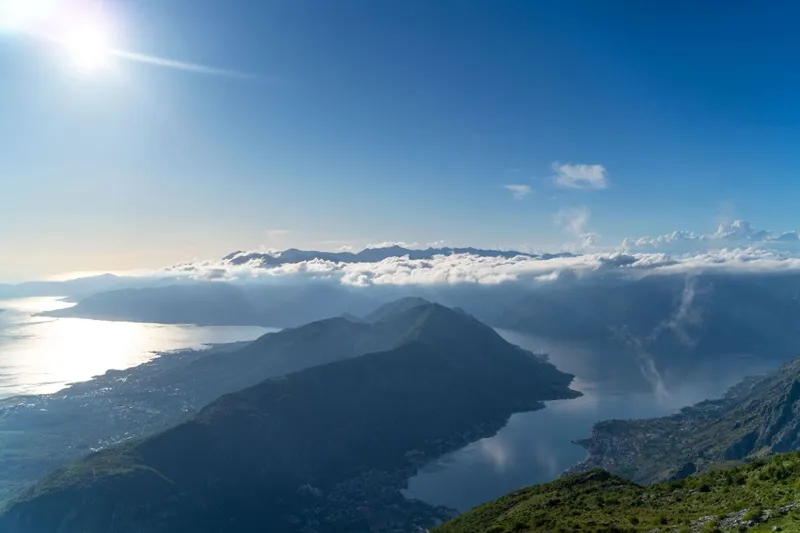
Herceg Novi sits on the open-Adriatic side of the Verige Strait, the 340-metre-wide neck that compresses the Bay of Kotor into its inner basins (Wikipedia: Bay of Kotor). Cross Verige eastbound and you are inside the bay's inner sanctum — Kotor, Perast, Risan. Stay west of it and you are at the bay's mouth, with the Lustica peninsula on your port side, the Croatian border on the starboard side, and a straight shot to the open sea.
That position is the whole story. The town was founded in 1382 by Bosnian King Stefan Tvrtko I, who needed an outlet on the Adriatic and named the new harbour "Herceg" — Duke — for the heir Stjepan Vukčić Kosača (Wikipedia: Herceg Novi). Six and a half centuries later the geography still drives the boats. From a Kotor pier, every speedboat headed to Blue Cave or Mamula passes Herceg Novi water on the way out and back. From a Herceg Novi pier, the same tour starts almost at the destination.
Why arrive by boat: the launch-distance advantage
Most travelers think about Herceg Novi as a destination. Captains think about it as a port. Here is why.
- Kotor → Blue Cave: ~14 nautical miles each way, about 50 minutes of sailing one way
- Herceg Novi → Blue Cave: ~3.5 nautical miles, about 15 minutes one way
- Kotor → Mamula: ~13 nm each way, ~45 minutes
- Herceg Novi → Mamula: ~1 nm, under 5 minutes
- Herceg Novi → Žanjic beach (Lustica): ~3 nm, ~12 minutes
The numbers compound. A 6-hour Kotor circuit spends roughly 2 hours in transit and 4 hours on stops. The same routing from Herceg Novi spends 30 minutes in transit and 5.5 hours on stops. That is not a marginal difference — it is the difference between seeing one swim spot well and seeing four.
Captain's Tip
Captain's-log rule of thumb: if your trip's anchor activity is Blue Cave plus Mamula plus a Lustica beach, the most efficient day starts west of Verige. If your anchor is Perast and Our Lady of the Rocks, it starts east of Verige. The bay is small, but the strait sorts the routing for you.
There is a wind angle too. The bora — the cold north-easterly that blows down off the Lovćen massif — hits the inner bay harder than the mouth. When the morning forecast has bora gusts at 25-30 knots inside, conditions at Herceg Novi are often 10 knots calmer because the open Adriatic side does not funnel the same way. On a marginal day, launching west keeps the day on the water.

The Old Town from the water: Forte Mare, Kanli Kula, and the city of stairs
Approach Herceg Novi from the sea and the first thing you see is Forte Mare — the sea fortress — perched directly on the water at the Old Town's eastern edge. The fortress was built in the 14th century and rebuilt by the Venetians in the 16th, then restored again under Austro-Hungarian rule (Wikipedia: Forte Mare). Today its battlements host an open-air cinema in summer and the best sunset view on this side of the bay.
Look up from Forte Mare and the Old Town climbs the hillside in narrow tiers. The town's nickname is "the city of stairs" — local guides count more than 1,500 steps from the waterfront promenade up through Belavista Square and out to Kanli Kula at the top. Kanli Kula, the "Bloody Tower," is a 16th-century Ottoman fortress that now functions as a 1,000-seat open-air amphitheater (Wikipedia: Kanli Kula). If a film festival or a concert is on, this is the venue.
East of the Old Town, perched on the wooded slope above Meljine, is Savina Monastery. Foundation traditions date its origins to the 11th century, though the present Great Church of the Dormition was built between 1777 and 1799. The monastery's collection includes a 13th-century Bogorodica Savinska icon that pilgrims still come to see. From the water you only catch glimpses of it through the cypresses, but a 20-minute taxi or a 40-minute walk from the Old Town gets you in.
Igalo: the mud, the spa, and the long swim
Drive five minutes west of the Old Town and you are in Igalo — technically the same municipality, structurally a different town. Igalo is the spa annex: a long, gently-shelving beach, a kilometre-long seafront promenade, and the Institut Dr Simo Milošević, which has used the local peloid mud (a black, mineral-rich estuarine sediment) for medical therapy since 1949 (Wikipedia: Igalo).
For boat travelers Igalo is mostly a swim stop and a coffee stop. The beach is sand-and-pebble rather than the sharp limestone you get at most Boka coves, which makes it the easiest entry-and-exit point on this stretch for travelers with kids or weak knees. The promenade has more cafes per metre than the Old Town does, and the food is cheaper. For an afternoon on the water that wraps with a flat-water swim and a cappuccino on the boardwalk, this is the closing scene.
Captain's Tip
Igalo's mud is dredged from a specific estuary and processed at the institute — the random black mud you find on the beach is not the same product. If the peloid therapy is on your list, book it through the institute, not from a beach vendor.
Half-day vs full-day: two routings that work
Herceg Novi works at two scales. A half-day ashore — three hours on the Old Town stairs, the forts, and a coffee — is enough to read the place. A full day on the water from the Herceg Novi side is the way to use the launch advantage. Most Kotor-based itineraries stitch them together in different proportions. Here is what we actually run.
Half-day on land (3 hours)
- 0:00 — Drop at the Old Town's western pier, Tabačina
- 0:15 — Belavista Square (the chess board in the stones is the photo)
- 0:35 — Forte Mare ramparts, sea-side battlement walk
- 1:00 — Climb to Kanli Kula via the 1,500 stairs (slow pace, water bottle)
- 1:45 — Coffee at one of the Belavista or Trg Marka Vojnovića cafes
- 2:15 — Drive or taxi to Savina Monastery (10 min)
- 2:45 — Re-board the speedboat at Tabačina
Full day on the water (8 hours, Herceg Novi launch)
- 0:00 — Depart Herceg Novi marina (Škver or Tabačina pier)
- 0:05 — Mamula slow circumnavigation, 12 minutes
- 0:25 — Blue Cave entry, 20 minutes inside
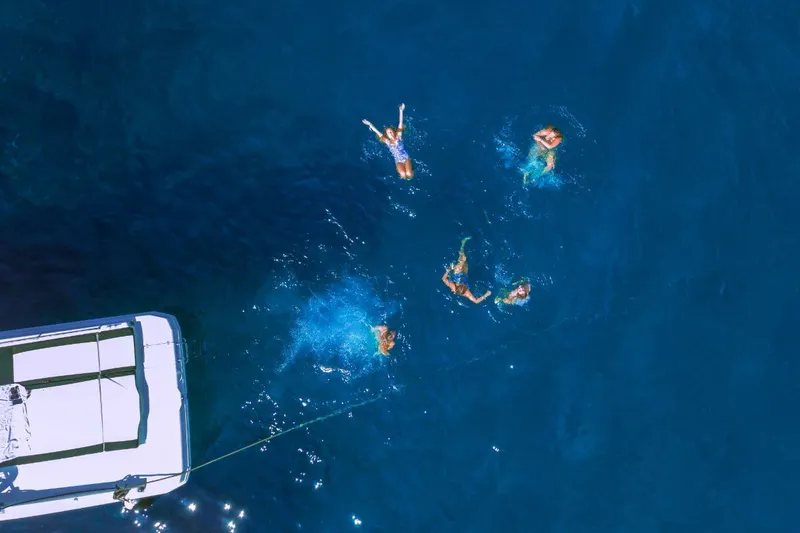
- 1:00 — Žanjic beach swim and lunch, 90 minutes
- 2:30 — Mirišta cove for a quieter swim, 60 minutes
- 3:30 — Slow leg up the bay through Verige to Perast
- 4:30 — Our Lady of the Rocks photo stop, 20 minutes
- 5:00 — Return leg via Tivat (slow pass)
- 6:30 — Igalo Beach swim and a cafe coffee, 60 minutes
- 7:30 — Sunset at Forte Mare from the water
- 8:00 — Back at Herceg Novi marina
The full-day version is what the launch-distance advantage actually buys you: four flagship Boka stops plus two beach swims plus a sunset, all in a single day with under an hour of total transit. From a Kotor pier the same itinerary is a 9.5-hour day with two hours of sailing, and most fleets will not run it.
Boat-only stops within reach
The reason Herceg Novi is worth the launch is not the town itself — it is what is within 30 minutes of its pier. Five places on this list are flagship attractions of the Bay of Kotor, and none of them have road access. They are boat-only.
- Blue Cave (Plava Špilja) — sea cave on the southern Lustica cliff, peak refracted light between 11:00 and 13:00. Detail in our Blue Cave guide
- Mamula island — 1853 Austro-Hungarian fortress on a 200 m circular islet, converted to a luxury resort in 2023. Background in our Mamula deep-dive
- Žanjic beach — 350 m of white pebble on the south Lustica side, Blue Flag accredited, the bay's most photographed swim
- Mirišta cove — small sand-and-pebble cove with one of the bay's better beach restaurants for a sit-down lunch
- Dobreč — secluded south-facing cove that only opens up by sea, photographers' favourite
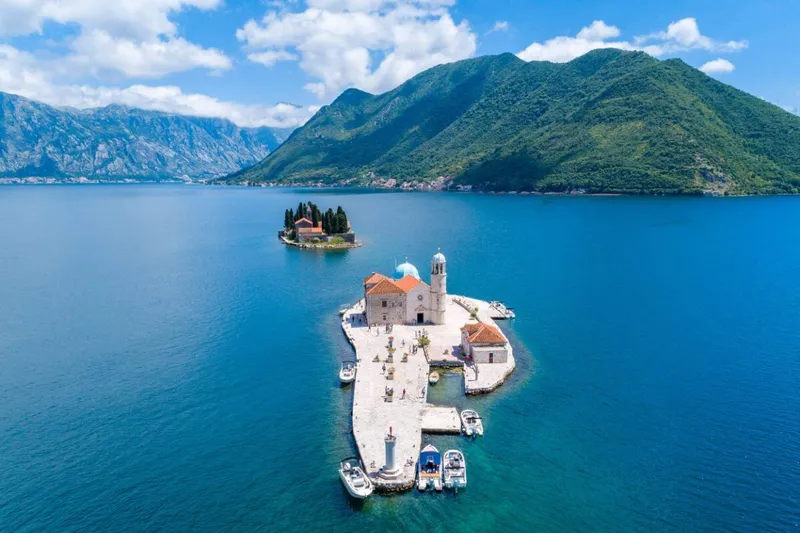
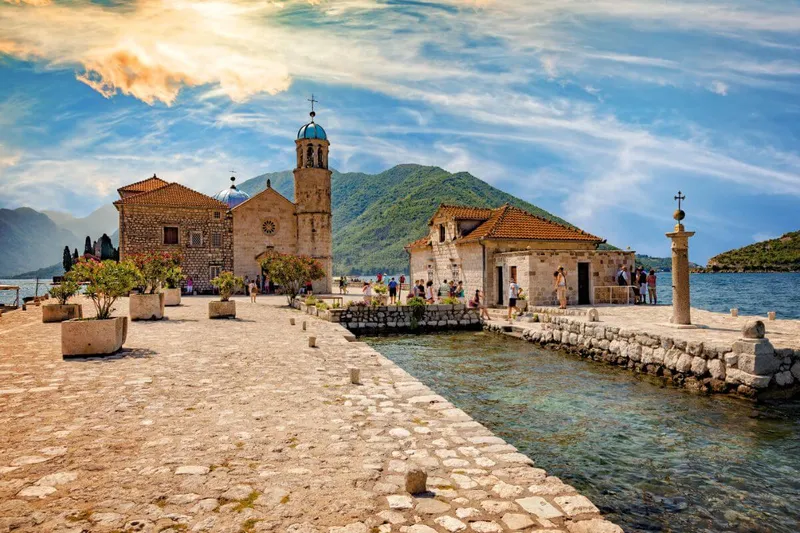
- Sveti Đorđe and Our Lady of the Rocks — Perast's two islets, 25 minutes east through Verige
For the full Lustica circuit beyond what we list here, see our Lustica peninsula by boat playbook. The Herceg Novi launch turns that 6-hour circuit into a 4-hour circuit.
Arriving from Dubrovnik: the cross-border angle
Dubrovnik to Herceg Novi by car is roughly 45 km via the Cavtat–Debeli Brijeg border crossing — under an hour without queues, two hours in peak August. That makes Herceg Novi the closest meaningful Montenegrin town to Dubrovnik, and the most efficient one for a day trip if your anchor is the boat day rather than the Kotor Old Town. We cover the broader cross-border logistics in Dubrovnik to Kotor day trip; the Herceg Novi version trims an hour each way off that itinerary.
Captain's Tip
If you are based in Dubrovnik and your goal is the boat day, drive to Herceg Novi rather than Kotor. You save two hours of road time and gain two hours of swim time. The math wins every time.
Best months and sea conditions
The water at Herceg Novi warms to 22 °C by mid-June and stays above 22 °C until early October. July and August sit at 25-26 °C — warm enough that you stop noticing the entry. The wind picture follows the bora schedule: peak risk is September through May, with calm shoulder seasons either side. The Mimosa Festival in February is the off-season highlight on land — a week of yellow blossom, parades and seafood — but the boats stay docked.
- May: sea ~19 °C, fewer crowds, all stops open, occasional bora
- June: sea 21-22 °C, the sweet spot before the August surge
- July-August: sea 25-26 °C, peak crowds, peak prices, peak heat
- September: sea 24 °C, crowds drop sharply mid-month, best month for the full Herceg Novi launch day
- October: sea 21 °C in the first half, weather variable, last reliable boat days fall in week 1-2
- November-April: shoulder shore visits only, no scheduled boat departures
Captain's tips, the things nobody else mentions
- Marina choice: Tabačina pier is closer to the Old Town stairs; Škver is closer to the marina restaurants. We use Tabačina for half-day-ashore drops and Škver for full-day swim launches
- Lunch on the water: Mirišta has the better food, Žanjic has the better swim — the pro move is to swim at Žanjic and walk over the headland for lunch at Mirišta
- Photo stop: Forte Mare ramparts, last hour before sunset, looking back at the Old Town stairs catching the light
- Coffee stop: Trg Marka Vojnovića (the chess-board square) is the local choice; the waterfront promenade is the tourist tier
- Mimosa February: if your trip lands in late February, the festival is real and worth the day, but plan a road-only itinerary
- What we do not recommend: Herceg Novi as a base for the Perast / Our Lady of the Rocks day. That itinerary lives east of Verige and adds an hour each way from this side
The 6h Bay & Lustica circuit, including Herceg Novi water
Blue Cave, Mamula slow circle and a Lustica beach lunch — the same waters as a Herceg Novi launch, depart from Kotor old town pier.
Want it private? Book the 6h bay circuit on your own boat
The full Boka loop with Herceg Novi water on a private speedboat — your routing, your pace, up to 12 guests.
Short on time? The 3h shared option
Blue Cave, Mamula pass and one beach swim in three hours, four daily departures from Kotor old town pier.