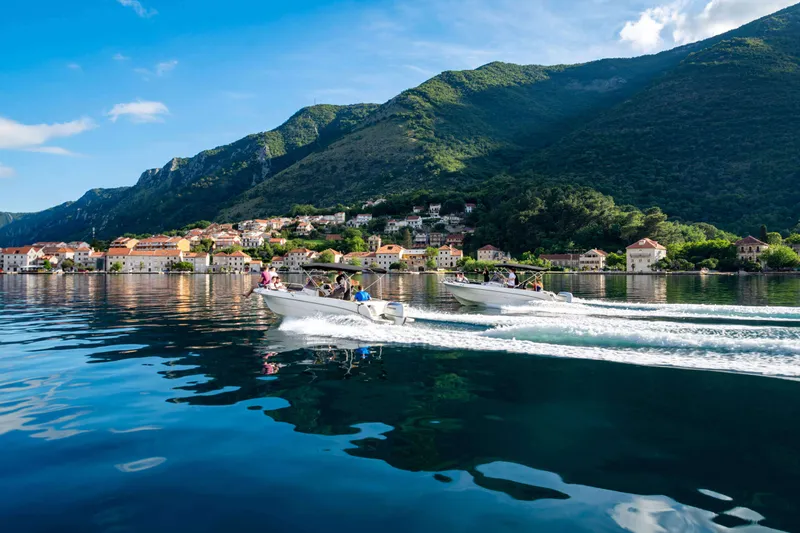
Every speedboat that runs the Perast route in Boka Bay passes Risan. It sits at the innermost point of the bay's quietest arm, a straight shot from the Verige Strait, and almost every itinerary treats it as scenery rather than a stop. That is a mistake with the town that is, by a wide margin, the oldest continuously inhabited settlement in the entire Bay of Kotor — older than Kotor, older than Perast, older than the Venetian towns that get all the photographs.
This is a captain's-log guide to why Risan is worth 45 minutes off the standard route: the Illyrian queen who made her last stand here, the Roman mosaic that exists nowhere else in the Balkans, and how to fold a stop into a Kotor Bay boat day without losing the rest of your itinerary. For the wider region, see our Bay of Kotor pillar guide.
Risan at a Glance
The oldest town in the bay, and why nobody stops there
Boka Bay has five historic towns — Kotor, Perast, Tivat, Herceg Novi, and Risan — and Risan is the only one most visitors never hear of. Part of that is geography: it sits at the far end of the Bay of Risan, the bay's quietest and most enclosed arm, well past the point where most road traffic and most boat tours turn back toward Perast and Kotor. Part of it is that Risan has no Old Town wall, no baroque waterfront, no postcard silhouette. What it has instead is 2,500 years of continuous history, most of it underground.
Risan's Illyrian name was Rhizon. It was already an established settlement when the Illyrian king Agron and, after his death, Queen Teuta built it into the capital of the Ardiaean kingdom in the 3rd century BC. When Rome went to war with Teuta's fleet in 229 BC — the First Illyrian War — Rhizon was her last stronghold. Local tradition holds she died here after her surrender, and the town's old name, cursed in some tellings by the queen herself, still carries her memory (see Wikipedia: Rhizon).

The Roman mosaics: a god found nowhere else in the Balkans
Rome annexed the bay after the Illyrian Wars and rebuilt Rhizon as Rhisinium, a free municipium whose citizens paid no imperial tax — a privilege dating back to a decree under the earlier Illyrian king Gentius. The town flourished through the 1st and 2nd centuries AD, and what survives from that period is the reason to actually get off the boat: the floor of a 2nd-century Roman villa, discovered by accident in the early 20th century and now displayed under a protective roof on its original site (Muzeji Kotor: Roman Mosaics).
Most rooms carry geometric and floral tesselation — handsome, but the kind of thing you can see at dozens of Roman sites around the Adriatic. One room is different. It holds a mosaic of Hypnos, the Greco-Roman god of sleep, shown as a reclining half-naked youth with small wings at each shoulder, touching the eyes of the weary with a twig dipped in the river of forgetting. Archaeologists consider it the only known depiction of Hypnos in this form anywhere in the Balkans — a genuinely rare survival, not a marketing line.
Captain's Tip
Captain's-log note: the mosaic site is small — you need 20–30 minutes, not half a day. Admission runs around €5–€6 and the site is typically closed Mondays; hours shift seasonally, so check locally before you plan a tight window.
Why boat tours skip it — and why that is exactly the appeal
Risan does not sit on the fast line between Kotor and Perast — it is a detour up the bay's northern arm, and most shared tours are built around a tight clock: Blue Cave, Our Lady of the Rocks, back to port. Adding Risan means adding 45 minutes to an hour of sailing on a route that already has a schedule to keep, which is why it rarely appears on a standard shared-tour stop list.
That absence is precisely why it rewards a private or flexible booking. There is no queue at the mosaic site. There is no crowd at the small waterfront. You are looking at a 2nd-century Roman floor with a handful of other visitors, if that, fifteen minutes after leaving a bay that had four cruise ships in it. For travelers who have already done the Blue Cave and Our Lady of the Rocks circuit and want the version of Boka that most itineraries never reach, Risan is that stop.
Folding Risan into a Kotor Bay boat day
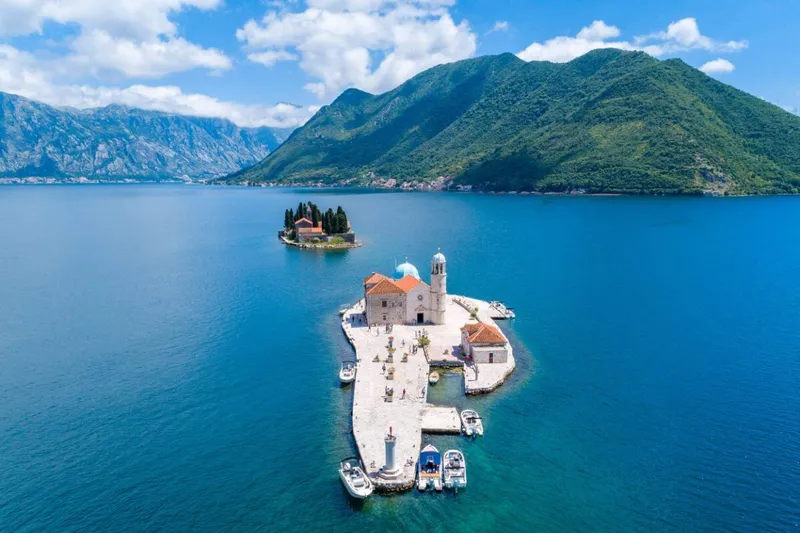
Risan sits roughly 30 minutes by speedboat from Kotor and about 12 minutes from Perast — close enough to add to an already-flexible day without rebuilding the whole route. It works best as an extension of a private full-bay circuit rather than a standalone trip, since the payoff is the contrast: baroque Perast, then twelve quiet minutes further up the bay to a 2,500-year-old capital most other boats never reach.
- Best paired with: a private full-bay tour that already includes Perast and Our Lady of the Rocks — Risan is the natural extension once you are that far up the bay
- Time needed on land: 30–45 minutes at the mosaic site, plus a short walk along the quiet waterfront
- Best months: May through early October, same sailing window as the rest of the bay
- What not to expect: no Old Town walls, no baroque waterfront — come for the mosaics and the history, not a postcard skyline
See the whole bay, Risan included
Our private 6-hour Kotor Bay circuit already runs past Risan's waters on the way to Perast — ask your skipper to add the mosaic stop.
Already doing Perast? Risan is 12 minutes further
Our Lady of the Rocks and Perast in 1.5 hours — the easiest add-on point for a Risan detour if your skipper has flexibility in the schedule.
Risan does not appear on our shared, fixed-schedule tours — the detour does not fit their clock. It is a private-charter and flexible-route stop, which is exactly the case for booking a private boat if the bay's older, quieter history is part of what you came for. See our day trip to Perast guide for the town Risan sits just beyond, and our private charter guide for how flexible-route bookings work in practice.