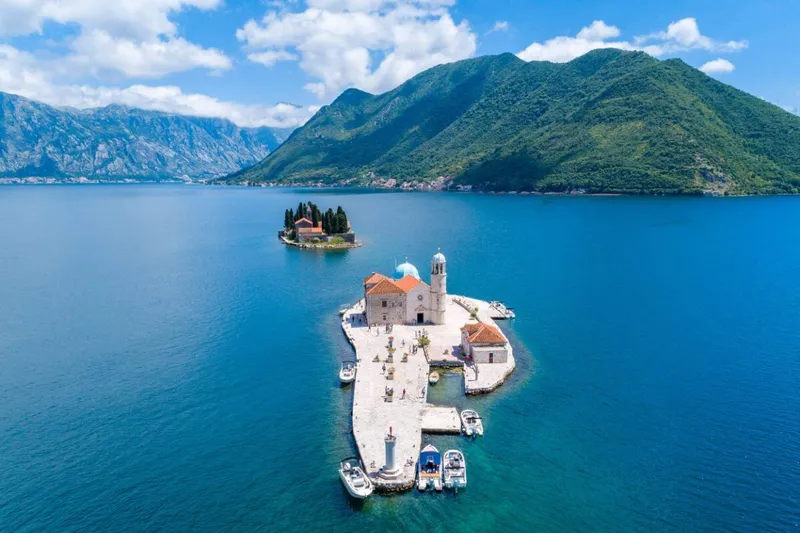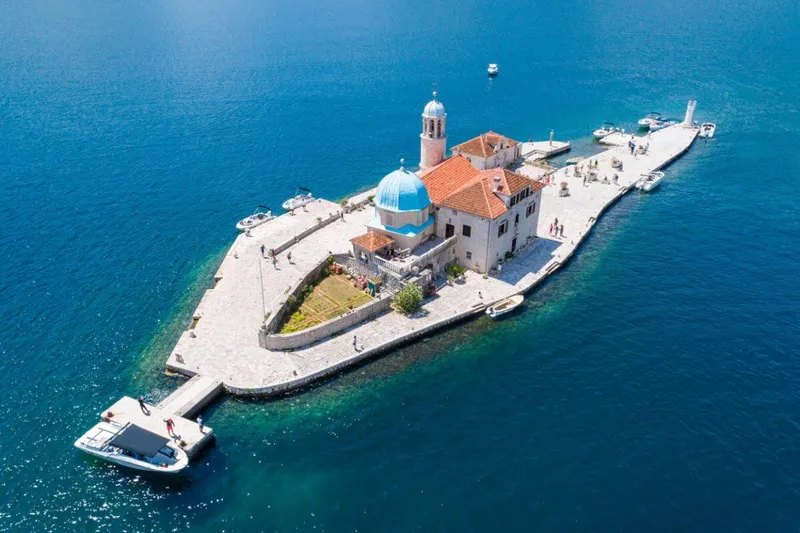
Our Lady of the Rocks — known locally as Gospa od Škrpjela — is the only man-made island in the Adriatic. For 572 years, sailors returning safely to the Bay of Kotor have dropped a rock at the same submerged reef, and over centuries those rocks became an island. The church sitting on top of that island, built in 1632, holds 68 baroque paintings, around 2,500 silver votive tablets left by returning mariners, and one embroidered tapestry whose maker spent 25 years weaving it — partly with her own hair.
Most visitors see it for 20 minutes on a boat tour, take a photo, and leave. This guide goes deeper: the 1452 legend, the July 22 Fašinada ceremony, how the island differs from its natural twin near Perast, and how to visit in 2026. We drive past it every day; the story never gets old.
Our Lady of the Rocks — At a Glance
The 1452 Legend — Two Brothers and a Miraculous Icon
According to local tradition, the story begins in 1452 when two fishermen brothers from Perast, returning home at sunset, found an icon of the Virgin and Child resting on a rock barely breaking the water's surface. One brother was gravely ill. They took the icon home, and the sick brother recovered overnight. Believing this a sign, the villagers vowed to build a shrine on the rock where the icon had appeared.
They had one problem: the rock was 150 metres offshore, in 5 metres of water. You cannot build a church on a submerged reef. So they started dropping stones. On the anniversary of the discovery each year, the fishermen of Perast sailed out to the site and added rocks. Sunken ships, no longer seaworthy, were stripped and scuttled onto the pile. Over nearly two centuries of this slow accretion, the underwater reef became a visible island. The first chapel went up on the growing platform in 1484.
The icon itself is still inside the church today, above the main altar. Local belief treats it as miraculous. For sailors of Perast during its golden age under Venice — when the tiny town produced 12 admirals and trained Peter the Great's Russian navy — returning safely to see the icon was synonymous with making it home.
How Do You Build an Island from Rocks?
The process that created Our Lady of the Rocks has a name: Fašinada, from fascina — a bundle of sticks and stones thrown into the sea. What began as a practical way to widen a shrine foundation became a 572-year-long community ritual. The island you see today — roughly 3,030 square metres of flat platform — is the cumulative result of that dropping, stone by stone, every year since 1452.
Modern archaeology suggests the natural reef was probably a low sandbar already — not fully submerged but close to it. The Fašinada tradition raised it high enough to support walls, a roof, and the 11-metre bell tower. By the time the church was rebuilt in its current baroque form in 1722, the island was stable enough to hold a structure that has now survived three centuries, two earthquakes (1667 and 1979), and countless storms.
Locals didn't stop once the island was finished. Rocks still go in, to this day. The tradition moved from a functional act to a ceremonial one, and we'll cover the modern version in the Fašinada section below.
Inside the Church — 68 Paintings, 2,500 Silver Votives, One Tapestry
The current church, built in 1632 and expanded in 1722, is modest on the outside — a single nave, a bell tower, a blue Byzantine dome. Inside, it's one of the most densely decorated baroque interiors in Montenegro. The ceiling and upper walls hold 68 paintings by Tripo Kokolja, a Perast-born painter who trained in Venice and returned home in the late 1600s. The central ceiling piece — the Death of the Virgin — took him 10 years.
The walls are lined with silver votive tablets — small embossed plaques left by sailors and travellers after safe voyages or answered prayers. Estimates put the number at around 2,500, dating from the 17th century to the present. Some depict ships in storms; others show saints; a handful just say thanks. Each tablet is a private story left publicly.
One object in the church is singular: an embroidered tapestry by Jacinta Kunić-Mijović, a Perast noblewoman who spent 25 years (1812–1837) working on it while waiting for her sailor fiancé to return. He did not. The tapestry depicts the Virgin with gold and silver thread — and where the thread ran out, she continued in her own hair, which visibly fades from brown to grey across the later years of the work. The tapestry is preserved behind glass in the adjacent museum.
Our Lady of the Rocks vs St. George Island — The Twin Islets
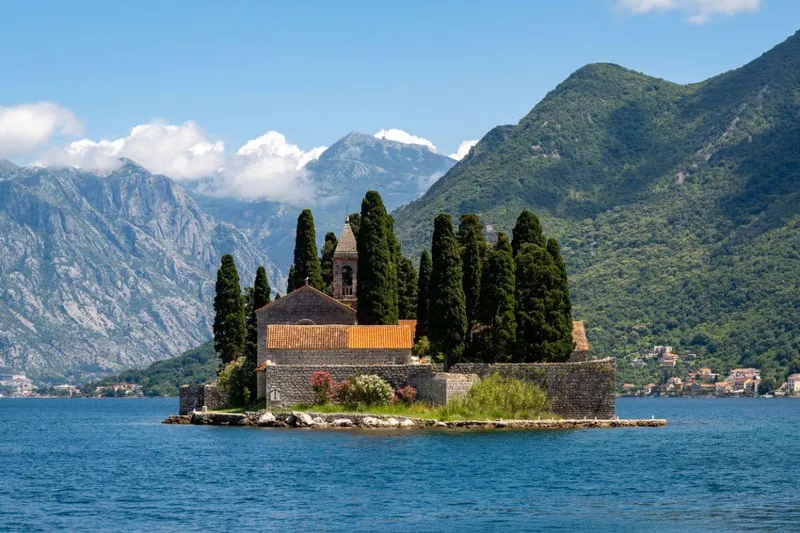
Visitors often confuse the two islets 150 metres off Perast — they sit close together in the same stretch of water. They could not be more different. Our Lady of the Rocks is man-made, open to visitors, and built around a Marian legend. St. George's Island (Sveti Đorđe) is a natural limestone outcrop with a 12th-century Benedictine monastery and the old graveyard of Perast. The Benedictines are gone, but the graves remain, shaded by dark cypress trees.
St. George's is private — no landing, no tours. Only priests and members of certain Perast families (who still bury their dead there) can set foot on it. Every boat tour passes both, but you'll only disembark at Our Lady of the Rocks.
- Our Lady of the Rocks — man-made, 1632 church, open to visitors, 20-min stop on tours
- St. George's Island — natural, 12th-century monastery, private, boat passes closely
- Distance between them — about 200 metres, both visible from Perast waterfront
- Photographic pairing — the two-island shot from Perast is one of Montenegro's most recognised frames
The Fašinada Ceremony — July 22 Every Year
Every year on the evening of July 22, the original tradition repeats. A procession of decorated boats — local fishermen, families, visiting yachts, our own fleet most years — sails in single file from Perast harbour to Our Lady of the Rocks at sunset. Each boat carries stones. One by one, the boats circle the island and drop the stones into the water at the foundation. The ritual is silent except for a brass band on the church terrace.
The ceremony has run continuously for 572 years. It doesn't stop for weather (though rough seas shift the start by an hour or two), and it doesn't stop for tourism — the boats are local, the stones are local, and visitors are welcome as spectators but not as participants. If your Montenegro trip overlaps July 22, book a sunset tour early: space fills up six months ahead.
Captain's Tip
Fašinada evening tours from Kotor are the single most-requested booking of the year. If you're visiting in July 2026 and want to see the ceremony by boat rather than from Perast waterfront, book by late April. Our spots for July 22 are usually gone by May.
How to Visit Our Lady of the Rocks in 2026
Our Lady of the Rocks is only reachable by boat. There is no land bridge, no ferry, and no swimming access for visitors. Three tour lengths include a stop at the island, each with a different amount of time on-site:
- 1.5-hour Our Lady of the Rocks & Perast (private) — Shortest option. 20 minutes on the island, including entry to the church. Hourly departures 09:00–17:00 from Kotor. Good for travellers short on time or avoiding the open Adriatic.
- 2-hour Perast & Our Lady of the Rocks (shared) — Our most-booked tour. 30 minutes at the island, time to enter the church, browse the small museum, and buy a postcard. Six daily departures 09:00–19:00. The standard cruise shore excursion.
- 3-hour Blue Cave Adventure (shared) — Adds the Blue Cave and Mamula Island, but reduces Our Lady of the Rocks time to about 15 minutes. Four departures daily. The choice if you want to see everything.
All three depart from Park Slobode 1 in Kotor, 3 minutes' walk from the cruise terminal. Church entry requires a €1 donation at the door (exact change appreciated — the priests run the church, not a till). Shoulders covered is customary.
The 2h Perast & Our Lady of the Rocks Tour
30 minutes at the island with time to enter the church and see the Kokolja ceiling. Six daily departures from 09:00 to 19:00. From €35 per adult.
Photography — Perast Waterfront vs the Boat Approach
Our Lady of the Rocks is one of the most photographed sights in Montenegro, but the best shots aren't from the island itself. They're from two other places:
- Perast waterfront promenade — The classic two-island composition (Our Lady left, St. George right, both framed by stone houses behind). Shoot at blue hour (around 20:30 in July) for lights-on in the houses plus daylight still on the islands. The shot travel magazines use.
- Approaching boat, low angle — Photograph from water level as the boat closes in, church dome silhouetted against Perast behind. Works best at 17:00–18:00 when the western sun lights the island from behind the camera.
- Inside the church looking up — The Kokolja ceiling is hard to photograph without a wide-angle lens, but a phone panorama captures the feel.
- Avoid — Shooting from the island itself toward Perast at midday. The sun is behind the town, the light is flat, and the shot is always backlit.
Where the Rocks Still Come From Today
A detail most guides miss: the Fašinada tradition is still active. Locals from Perast and the surrounding villages continue to drop rocks at the island — not only on July 22, but informally throughout the year. A sailor returning from a long voyage, a family marking a safe delivery, a newly-married couple: the reasons vary. The rocks are quietly added. The island grows millimetre by millimetre.
If you ask one of the priests who staff the church, they'll tell you which nearby beach the stones are typically taken from (it changes over the decades as old sources get restricted for conservation). The rule is simple and unwritten: one stone per person per visit, no bigger than a fist, no paint or inscriptions. The Perast fishermen's association maintains the practice loosely — there is no formal body, no permit system. It just keeps happening.
Common Myths About Our Lady of the Rocks
A decade of taking visitors to the island, and a few misconceptions come up repeatedly. Setting them straight:
- Myth: The island is natural. It isn't. The original reef was probably a low sandbar, but the visible island is entirely built from sunken ships and dropped stones over the centuries since 1452.
- Myth: The icon was painted recently. The central Virgin-and-Child icon above the main altar is the same panel found in 1452, according to local tradition. It has been restored multiple times but the wood is original.
- Myth: You can buy a rock to drop. You can't. The Fašinada tradition is local and informal. Visitors are welcome as observers on July 22 but don't participate in the stone-dropping itself.
- Myth: St. George's Island is also visitable. It isn't. It remains private and closed to tours, though every boat passes within photographing distance.
- Myth: The tapestry was woven with only hair. Not quite. Jacinta Kunić-Mijović used gold, silver, and silk thread primarily; her hair was woven in where those threads ran out, visible as the darker strands that fade to grey across the later sections.
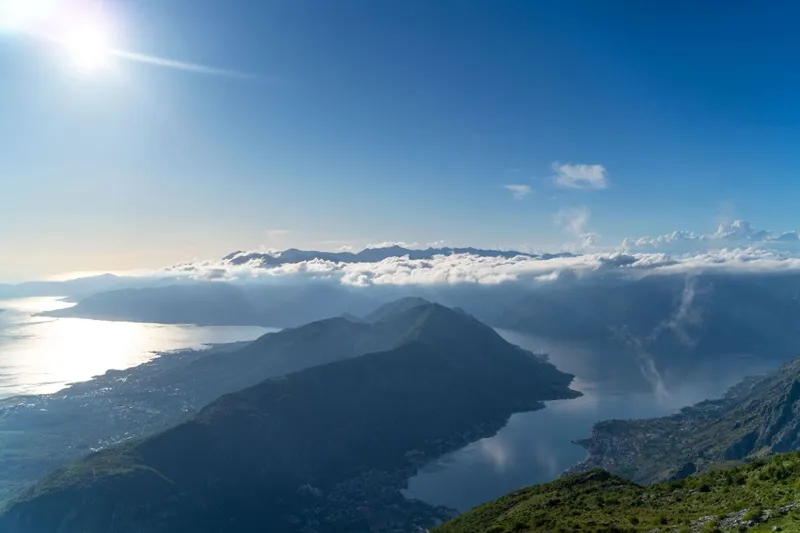
If you're planning a wider Bay of Kotor visit, Our Lady of the Rocks sits inside a well-connected loop. Our complete Kotor boat tour guide covers the full 2026 schedule, and the Bay of Kotor guide places the island in its wider geography and history.
Related reading on the bay: