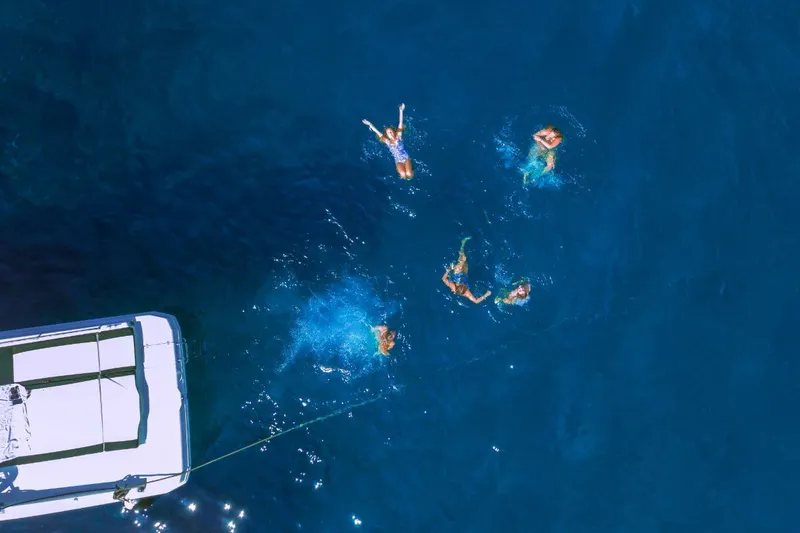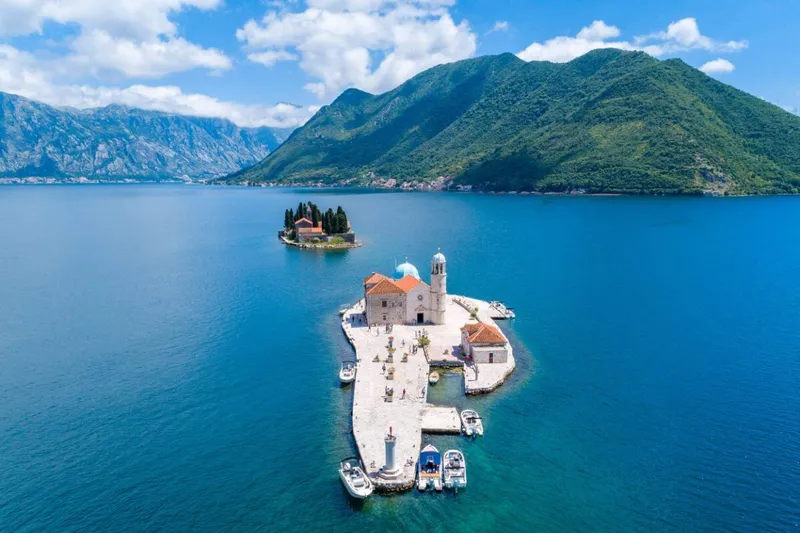
The Bay of Kotor — known locally as Boka Kotorska and widely as Boka Bay in the UK — is a 28-km winding Adriatic inlet in Montenegro and a UNESCO World Heritage Site since 1979. Often called Europe’s southernmost fjord, the bay is a dramatic ria sheltered by limestone mountains rising 1,700 m straight from the sea.
Bay of Kotor at a Glance
Steep limestone walls plunge into deep blue water, sheltering medieval stone towns, island churches and hidden coves that have barely changed in centuries. As captains who have navigated Boka Bay for over a decade, we’ve put together this guide to share everything visitors need to know — whether you’re arriving by cruise ship, driving the coastal road, or booking a boat tour from our tours.
Though geologically the bay is a submerged river canyon rather than a glacial fjord, the visual impact is the same: an enclosed body of water surrounded by mountains, with mirror-calm straits, waterfront baroque towns, and some of the cleanest swimming water in the Mediterranean.
Geography and Layout of Boka Bay
The Bay of Kotor is made up of four smaller bays connected by narrow channels. From the open Adriatic moving inland, you pass through:
- Bay of Herceg Novi (Topla Bay) — The outermost basin, home to the resort town of Herceg Novi and the entrance from the Adriatic. This is where you’ll find the old Austro-Hungarian fortresses and the wartime prison island of Mamula.
- Bay of Tivat — A broad central basin containing Tivat Airport, the luxury Porto Montenegro marina, and the Luštica Peninsula coastline. The Verige Strait connects it to the inner bay.
- Bay of Risan — The quiet northern arm, home to the ancient Illyrian town of Risan with its 2nd-century Roman mosaics, backed by the tallest mountains of the massif.
- Bay of Kotor — The innermost and most dramatic basin, where the walled Old Town of Kotor sits at the foot of Mount Lovćen. This is where cruise ships dock and where most boat tours begin.
The narrowest point is the Verige Strait, only 300 metres wide. Medieval chains once stretched across it to block enemy ships — the strait takes its name from those chains (verige means “chains” in the local language). Today it creates a natural division between outer and inner bay, and passing through it by speedboat remains one of the most impressive moments of any tour.
A Brief History of the Bay of Kotor
Boka Bay has been continuously inhabited for over three thousand years. The earliest known settlers were the Illyrians, whose Queen Teuta fought naval campaigns from Risan in the 3rd century BC. The Romans arrived in 168 BC and left behind the mosaics still visible in Risan today — among the best-preserved Roman mosaics on the Adriatic.
The bay’s architectural character was set during the Venetian period (1420–1797). For nearly four centuries, Boka was a Venetian maritime province, and the stone palaces of Perast, the Venetian arsenal in Kotor, and the baroque churches that line the waterfront all date from this era. Perast alone produced 12 admirals and trained the Russian navy under Peter the Great in the early 1700s.
After a brief French Napoleonic period, the bay passed to the Austro-Hungarian Empire (1814–1918), which built the ring of coastal fortresses — including Mamula Island, Prevlaka and the forts above Herceg Novi — that still dot the shoreline. A catastrophic earthquake in 1979 damaged much of the old architecture, which triggered the UNESCO listing that same year and a decades-long restoration programme. Today the walled cities look largely as they did under Venice, and the bay is one of the most intact medieval seascapes in the Mediterranean.
Must-See Highlights
Kotor Old Town
A UNESCO-listed walled town enclosed by 4.5 kilometres of medieval fortifications. Inside is a labyrinth of narrow stone streets, Romanesque churches and small squares. The main attractions are the Cathedral of Saint Tryphon (consecrated 1166 — older than Notre-Dame de Paris), the Maritime Museum housed in the Grgurina Palace, and the city walls that climb 1,200 metres up the mountainside to the Fortress of San Giovanni. Allow 2–3 hours to wander the core of the old town.
Our Lady of the Rocks
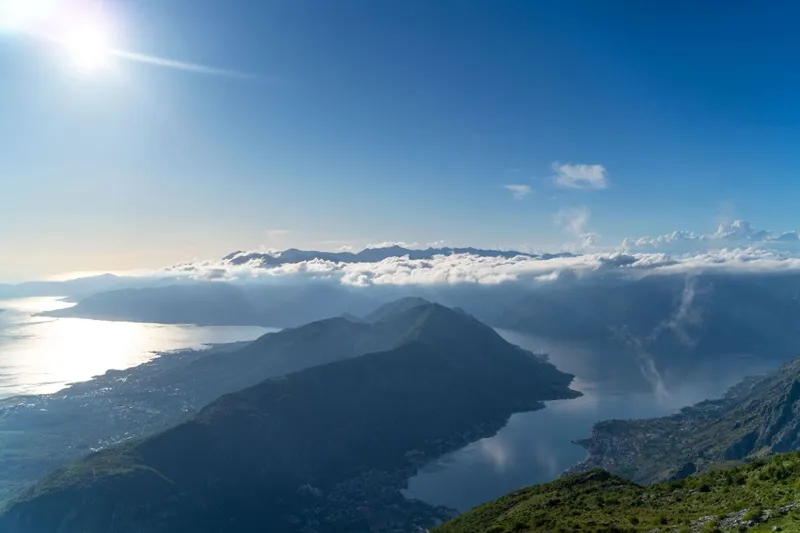
One of the most photographed sites in Montenegro. According to local tradition the island was created over centuries by sailors who dropped a rock at the site after each successful voyage; a custom still re-enacted every 22 July in the Fašinada ceremony. The church dates to the 17th century and houses an extraordinary collection of paintings and votive silver tablets offered by returning mariners. Read more about Our Lady of the Rocks.
Visiting by boat is the only way to reach the island. Our 2-hour Perast & Our Lady of the Rocks tour and 3-hour Blue Cave Adventure both include a stop here with time to enter the church and small museum.
Perast
A tiny baroque town of stone palaces and churches sitting directly on the waterfront. With a permanent population of under 300, Perast feels frozen in time. The 16 palaces and 17 churches that line its single street were built during the town’s golden age as a maritime republic under Venice. Walk the waterfront promenade, climb the bell tower of St Nicholas Church for the best free view of Our Lady of the Rocks, and visit the Perast Museum in the Bujović Palace.
The Blue Cave
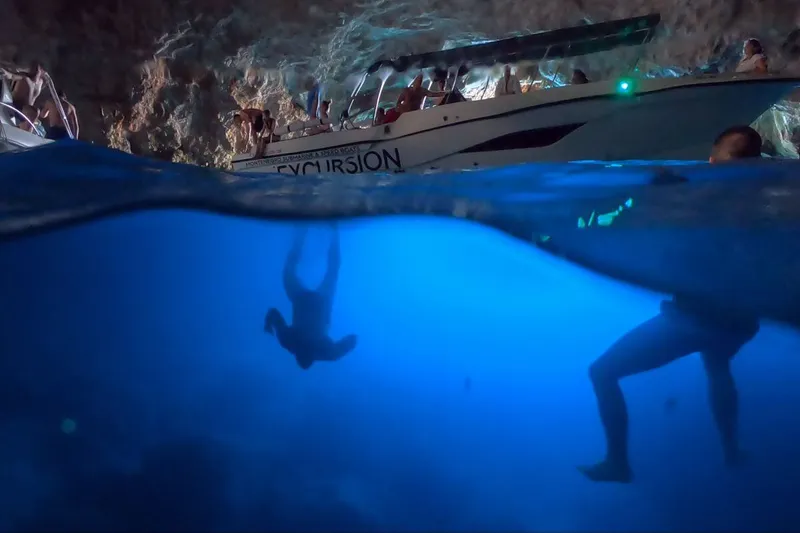
Located on the Luštica Peninsula near the entrance to the bay, the Blue Cave (Plava Spilja) is a natural sea cave where sunlight refracting through the underwater entrance creates an extraordinary turquoise-blue glow. The cave is large enough to enter by boat, and the water inside is calm and clear for swimming.
The blue is most intense in the morning when the sun is at the right angle. For this reason our most popular tours depart at 09:00 — if you book an afternoon slot the glow will be softer. The cave is only accessible by boat; there is no road access.
Tivat & Porto Montenegro
Tivat, 25 minutes from Kotor by car, transformed from a sleepy naval town into a luxury yachting destination after the 2009 opening of Porto Montenegro — now one of the Mediterranean’s largest superyacht marinas. The marina promenade, Regent Hotel and yacht showroom are open to visitors, and the old Arsenal submarine pens have been converted into bars and restaurants. The Kotor Panorama & Underwater Experience is the easiest way to see the bay for travellers short on time.
Herceg Novi
Guarding the western entrance to Boka Bay, Herceg Novi is the sunniest spot in the whole bay — it averages 200 more hours of sun per year than Kotor. The old town climbs steeply from the sea and is layered with fortifications from every period: the 14th-century Tvrdđava Forte Mare on the waterfront, the Austrian-built Kanli Kula (“Bloody Tower”), and the Spanish Fortress on the hillside above. It is a quieter alternative to Kotor for a longer stay.
Mamula Island
A circular Austro-Hungarian fortress built in 1853 to guard the mouth of the bay, later used as a prison camp during WWII. Mamula reopened in 2023 as a boutique hotel, but the waters around the island remain open to passing boats and are a favoured swim stop. The island and the nearby Blue Cave are often combined into a single tour. More on Mamula.
Risan
The oldest settlement in the bay sits at its quietest, innermost end. Risan was an Illyrian capital and the last refuge of Queen Teuta in the 3rd century BC, but the headline draw today is its remarkably preserved Roman mosaics — the floor of a 2nd-century villa, including a rare depiction of Hypnos, the god of sleep. It’s one of the most important Roman archaeological sites on the Adriatic and a peaceful detour from the busier western bays.
Experience Boka Bay by Speedboat
Our 3-hour Blue Cave Adventure covers all the outer-bay highlights: Blue Cave swimming, Our Lady of the Rocks, Mamula Island and a panoramic bay cruise. From 45€/person.
Hidden Beaches & Coves of Boka Bay
Most day-trippers never see these — they’re too spread out to reach by public transport and some are entirely boatable-only. If you’re spending more than a day in the bay, or hiring a boat, these are the swim stops locals use.
- Žanjic Beach — A pebble beach on the Luštica Peninsula near the Blue Cave. Turquoise water, a couple of simple beach restaurants, and calm conditions all summer. Often combined with a Blue Cave visit.
- Mirišta Beach — Žanjic’s tiny sister cove next door, with one restaurant and fewer visitors. Accessible by boat or a short walk from Žanjic.
- Dobreč Beach — Further out on the Luštica Peninsula, almost exclusively reached by boat. Shallow entry, white pebbles, and dense pine shade overhead.
- Rose — A fishing village on the tip of Luštica with a handful of waterfront konobas (traditional taverns). A popular lunch stop on longer tours.
- Trašte Bay — A long sandy stretch on the Adriatic side of Luštica — a contrast to the pebble beaches of the inner bay. Best in the afternoon when the sun lights the sand.
- Stoliv & Prcanj — Swimming platforms along the inner-bay promenade between Kotor and Tivat. Cool, clean water directly under the mountains. Free to use.
To reach these on your own schedule, consider renting a boat (no licence required up to 15 HP) or booking a private tour that can adjust to conditions and your preferences.
Best Ways to Explore the Bay
By Speedboat Tour
A speedboat tour is the most efficient and scenic way to see the bay’s highlights. In 2–3 hours you can cover the Blue Cave, Our Lady of the Rocks, Perast and the dramatic inner bay — distances that would take a full day by car and ferry. Shared tours start from 30€ per person; private tours from 90€ per boat (up to 6 passengers). See all tours.
By Car Along the Coastal Road
The road circling the bay (approximately 80 km total) offers continuous mountain and sea views. Allow a full day if you want to stop at viewpoints, visit towns and have lunch along the way. Key stops: the Vrmac viewpoint on the road to Lovćen, the charming waterfront of Perast, the Roman mosaics in Risan, and the Old Town of Kotor.
From a Cruise Ship
Cruise ships dock directly at Kotor Old Town, giving passengers immediate access to the historic centre. For those wanting to see more than the town itself, the speedboat tour departure point at Park Slobode is a 5-minute walk from the cruise port. The 2-hour Perast tour and 3-hour Blue Cave Adventure are the most popular shore excursions for cruise passengers. We guarantee you return to port on time.
Cruise Passenger? Perfect Shore Excursion.
Our 2-hour Perast & Our Lady of the Rocks tour is the highest-rated short excursion for cruise passengers — enough time to cover the inner bay and return to your ship comfortably. From 35€/person.
By Hiking
The hike to the Fortress of San Giovanni (1,350 steps) above Kotor Old Town takes 60–90 minutes and rewards you with an aerial view of the entire inner bay — arguably the single best photograph in Montenegro. For a more challenging option, the Ladder of Cattaro trail continues above the fortress to the mountain village of Krstač. Start before 09:00 or after 17:00 in summer to avoid the heat.
Captain's Tip
If you only have a few hours, take a speedboat tour. Boka Bay’s highlights are spread across 20+ kilometres of coastline, and a boat covers them all without the traffic and parking challenges of driving. For cruise passengers especially, a boat tour is the single best use of limited port time.
Day-Trip Cost Comparison
Rough comparison of what it costs to explore the main sights of the bay for a day (two people, assuming you’re already in Kotor):
- Shared speedboat tour — 60–90€ total (30–45€ pp). Covers 3–4 top sites including Blue Cave and Our Lady of the Rocks, 2–3 hours, all logistics handled.
- Organised coach tour — ~100€ total. Covers Perast and Kotor by land; does not include boat access to the Blue Cave. 6–8 hours.
- Rental car + fuel + parking — ~70–90€ total. Full flexibility, but you still can’t reach the Blue Cave, Mamula or Our Lady of the Rocks without a boat.
- Private driver for the day — 150–250€ total. Comfortable and guided, still land-only.
- Private speedboat tour — 90–250€ total (per boat, up to 6 people). Same route as shared, fully customisable, your own schedule.
- Self-drive boat rental — 150–500€/day (depending on boat size). Best for groups or multi-day stays; see rent a boat in Kotor.
For most first-time visitors, the shared speedboat tour is the best value per euro — it reaches the spots no land option can, and the logistics are taken care of. Only the rental-boat option rivals it on flexibility, and only for travellers confident piloting a small boat.
Best Photography Spots in Boka Bay
- Fortress of San Giovanni (Kotor) — Aerial-style shot of the whole inner bay from the switchbacks halfway up. Best at sunrise (05:30–07:00 in summer) before the cruise ships arrive and before the sun gets high.
- Vrmac viewpoint (road to Lovćen) — The classic picture-postcard shot of Kotor and the inner bay, taken from a roadside pull-out on the serpentine road. Golden hour is best.
- Perast waterfront promenade — The two-island shot (Our Lady of the Rocks and St George) framed by the Perast stone houses. Shoot at blue hour for lights on in the houses plus daylight on the islands.
- Verige Strait from water level — Impossible to photograph from land. A fast speedboat passing through the strait at golden hour gives mountains on both sides and a mirror-calm channel.
- Our Lady of the Rocks from a boat at sunset — The church silhouette with mountains behind. Our later-afternoon tours are designed around this light.
- Cruise ship deck at dawn — If arriving by cruise, be on deck 30 minutes before the ship enters the Verige Strait. The approach to Kotor is one of the most cinematic ship arrivals anywhere in the Mediterranean.
When to Visit
Boka Bay has a Mediterranean climate with hot summers and mild winters. Here’s the seasonal breakdown for planning:
- April – Early May: Cool to warm (14–22°C), quiet, wildflowers on the mountains. Water still cool (18–20°C) for swimming. Great for hiking and photography, tours run reduced schedules.
- Late May – June: Warm (22–28°C), uncrowded, water warming up for swimming (21–24°C). Ideal balance for boat tours.
- July – August: Peak season. Hot (30–35°C), busiest period with the most cruise ships (often 2–3 per day). Water at its warmest (24–26°C). Book tours in advance.
- September: Still warm (22–28°C), noticeably fewer crowds, best swimming conditions. Many regulars consider September the single best month to visit.
- October: Mild (18–24°C), quiet, water still warm (22–24°C) for swimming. Occasional rain but dramatic light for photography.
- November – March: Cool (8–16°C) and quiet. Kotor Old Town remains open year-round; boat tours operate on reduced winter schedules or pause entirely.
Practical Tips
Getting There
- By Air (UK visitors): Tivat Airport (TIV) has direct seasonal flights from London, Manchester and other UK airports via easyJet, TUI and Wizz Air; 8 km / 15 min drive from Kotor. Dubrovnik Airport (DBV) in Croatia has more year-round UK routes and is a 2-hour drive plus a quick border crossing.
- By Cruise Ship: Ships dock at Kotor Old Town or occasionally anchor in the bay with a tender service. The Verige Strait transit is a highlight in itself.
- By Bus: Regular services from Dubrovnik (2.5 hours), Podgorica (2 hours) and Budva (30 minutes).
- By Car: Drive from Dubrovnik via the border crossing at Debeli Brijeg. Allow 2–3 hours including the border wait in peak season.
Money & Essentials
- Currency: Euro (€) — Montenegro uses the euro despite not being in the EU. Card payments are widely accepted; carry cash for small konobas and entrance fees.
- Tipping: 10% is standard in restaurants; round up for taxi and bar bills.
- Mobile/Roaming: Montenegro is outside EU roam-like-at-home. Most UK carriers charge daily roaming fees — consider an eSIM (Airalo, Holafly) or a local SIM at Tivat Airport.
- Entrance fees: Our Lady of the Rocks church museum 2€ pp, Kotor city walls 15€ pp (May–Sep), most other historic sites free.
- Language: Montenegrin is the official language; Serbian, Croatian and Bosnian are mutually intelligible. English is widely spoken in tourism, Russian and German common too.
Where to Eat
Seafood dominates the local cuisine. In Kotor Old Town, look for konobas (traditional restaurants) in the quieter back streets rather than the main square — better value and usually better food. Perast has several waterfront restaurants where you can eat fresh fish with a view of Our Lady of the Rocks. For something different, our Organic & Hedonistic Discovery private tour combines a boat ride with a seaside organic lunch.
What to Bring on a Boat Tour
- Swimsuit and towel (for swimming in the Blue Cave)
- Sunscreen (reef-safe where possible) and sunglasses
- Light jacket — it can be breezy on the water even in August
- Camera or phone in a waterproof case
- Small amount of cash for the Our Lady of the Rocks entrance fee (2€ pp)
- Water bottle — we provide water but bringing your own is always a good idea
Frequently Asked Questions
Below are the questions our team is asked most often by visitors planning a trip to the Bay of Kotor.
Related reading on the bay: