Mamula Island — officially Lastavica on nautical charts — sits at the mouth of the Bay of Kotor, a perfectly circular chunk of stone built up by the Austro-Hungarians in 1853 to guard the bay from warships. Ninety years later it became an Italian fascist prison camp. In 2023 it reopened as a five-star resort. The same island has been three entirely different things to three generations of travellers, and all three stories matter if you're trying to understand what you're looking at from a boat.
We pass Mamula daily on our Blue Cave route. The question guests ask most often now isn't "what is it" — it's "can I still go?" The answer is nuanced. Non-guests can't set foot on the island anymore, but the water around it is open, the boat passes close, and the view from the sea tells the story better than any tour of the interior ever did.
Mamula Island — At a Glance
Where Is Mamula Island?
Mamula sits at the outer mouth of the Bay of Kotor, almost exactly between the tip of the Luštica Peninsula and the Prevlaka promontory that marks the Croatian border. Geographically it's the last outpost before the open Adriatic. Every ship entering or leaving the bay — cargo vessel, cruise liner, fishing boat, our speedboats — passes within 500 metres of it.
The island is small. Around 200 metres across. You can walk the circumference in under 10 minutes (if you could land). Its isolated, near-circular shape made it perfect for 19th-century coastal defence: all-around artillery coverage, no blind approach angle, natural moat on every side. The same features that made it a fortress also made it, later, an ideal prison — and, later still, an ideal luxury retreat for guests who don't want neighbours.
The 1853 Austro-Hungarian Fortress
Mamula was built in 1853 on the orders of General Lazar Mamula, the Austrian governor of Dalmatia, who gave the island its popular name. The Austro-Hungarians needed a ring of coastal forts to secure the Adriatic against the Ottoman and Venetian-successor fleets that still threatened the Dalmatian coast. Mamula, Punta d'Ostro (on the Croatian side), and Prevlaka together formed a crossfire zone at the bay's entrance.
The fortress was massive for its size: three floors of casemates (bomb-proof vaulted rooms), gun platforms on the roof, underground powder magazines, cisterns for 6 months of water, and sleeping quarters for 200 men. Its circular walls are 12 metres high and more than 2 metres thick at the base. It never fired a shot in anger. The technology of naval warfare moved past coastal forts within decades, and by 1914 Mamula was already obsolete as a weapon. It continued to function as a garrison and supply point until the end of WWI.
The Dark Chapter — Italian Prison Camp (1942–1943)
Mamula's hardest history is from the Second World War. After the 1941 Axis invasion of Yugoslavia, Italy occupied the Montenegrin coast and used Mamula from 1942 to 1943 as a prison camp — primarily for Montenegrin civilians, Partisan sympathisers, and local families suspected of resistance. The conditions were severe. Contemporary records suggest 130 prisoners died on the island from disease, starvation, and executions. The war ended before Mamula's role was fully documented, and many of the details came out only through survivor testimonies in the 1950s and 1960s.
For older residents of Herceg Novi and Luštica, Mamula remained an unhappy landmark. That history is the emotional reason the 2023 resort redevelopment was controversial — not the hotel itself, but the idea of a luxury hotel on that specific site.
The 2023 Resort Controversy
The Mamula redevelopment was first announced in 2015, when a Swiss-Egyptian investment group, Orascom, signed a 49-year lease from the Montenegrin government to convert the fortress into a five-star hotel. Local opposition was immediate and organised. Critics argued the site was a memorial that should not be commercialised; families of former prisoners organised the "Mamula Is Not For Sale" campaign; UNESCO raised questions about the site's historical integrity within the Bay of Kotor World Heritage zone.
The government held its position. The deal went ahead. After eight years of restoration work — during which the developer kept most of the original stone structure intact but added modern interiors, a pool, and a dock — the Mamula Island Hotel opened to guests in 2023. A small memorial to WWII victims was incorporated into the design, which was either adequate or inadequate depending on whom you asked.
In 2026, the hotel is operational, controversial, and expensive. The debate has quieted but not ended. For visitors, the practical question is simpler: what do you actually see from the water, and is it worth building a tour around?
Can Non-Guests Still Experience Mamula?
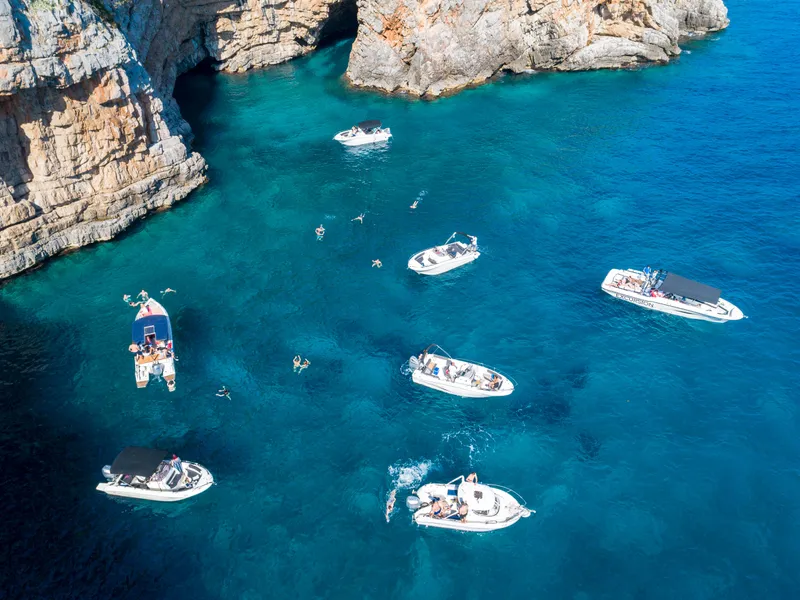
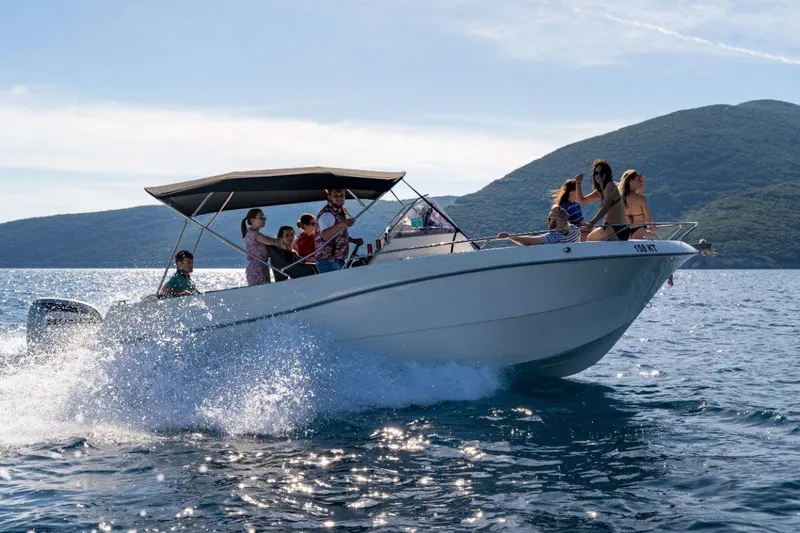
Yes — from the water. The hotel owns the island and its immediate dock but does not own the sea around it. Every licensed boat tour in Boka Bay passes Mamula at close range, typically within 40–60 metres of the outer wall. You can photograph the fortress in detail, see the restoration work from multiple angles, and (on calm days) swim in the surrounding water. What you can't do is land.
- Pass by boat — Every 3-hour Blue Cave Adventure and 6-hour Beach Transfer passes Mamula within 60 metres. Photographing is permitted.
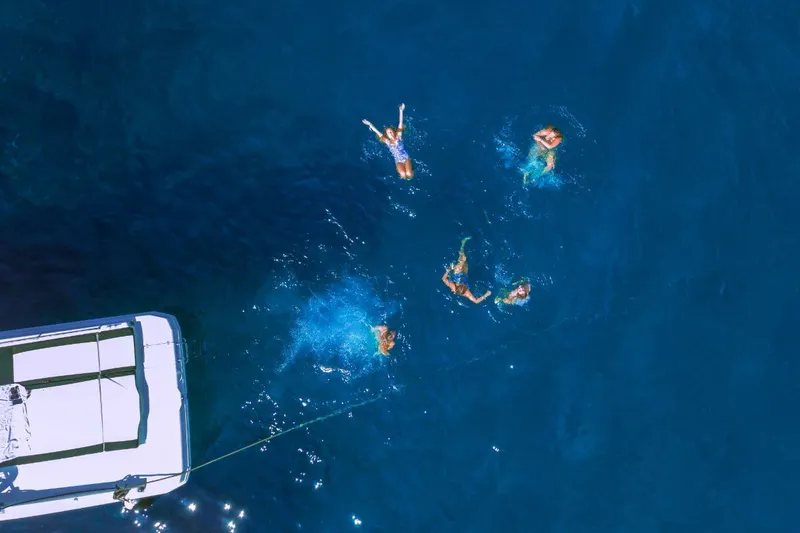
- Swim around it — Water outside the hotel's private dock is open. Our boats stop for 5-minute swim breaks if sea state permits.
- Visit the hotel — Day-guest access varies by season. The hotel has hosted day-use bookings for lunch and pool access at 200€+ per person, but this is not always available. Check the Mamula Island Hotel directly.
- Book a room — Rates start around 800€/night in 2026 for a full island stay. Transfer is by private boat from Herceg Novi.
- Not possible — Walking onto the island as a tour visitor, which was allowed before 2015.
Mamula Island Hotel — What Changed Architecturally
The restoration was done under heritage-protection conditions that kept the island recognisable. From the water, Mamula looks nearly identical to how it did in 1900: the same circular stone wall, the same height, the same weathered masonry. The differences are subtle and mostly interior.
- Exterior — Original 19th-century stonework preserved on all perimeter walls. No new structures above the original roofline.
- Casemates (vaulted rooms) — Converted into 32 hotel suites, each retaining the stone walls and vaulted ceilings of the original fortress rooms.
- Central courtyard — Former parade ground, now a pool and dining terrace visible from passing boats if you look over the top of the wall.
- Roof — Former gun platforms now a series of lounge terraces.
- Dock — New jetty built on the northeast side, replacing the original boat landing. Visible from the water.
- Memorial — Small installation for WWII prisoners inside the courtyard, not visible from outside.
Seeing Mamula By Boat — The 3h Blue Cave Route
The standard route that passes Mamula is our 3-hour Blue Cave Adventure, which runs Mamula into its full loop: Kotor → Verige Strait → Mamula → Blue Cave → Žanjice → Our Lady of the Rocks → Kotor. Mamula is the first outer-bay stop, hit about 35 minutes into the tour, and the boat circles slowly so all sides are visible.
For photography, afternoon light (14:00–17:00) is best — the sun hits the seaward side of the fortress at a low angle that brings out the texture of the stonework. Morning passes are brighter but flatter. Four daily departures at 09:00, 12:00, 15:00, and 18:00 mean you can pick the light that suits your camera.
Captain's Tip
If Mamula is the specific reason you're booking a tour, tell the captain on boarding. We'll circle a full revolution rather than the standard half-pass and slow down for cleaner photographs — no extra charge, but we only know to do it if you ask.
Mamula vs Our Lady of the Rocks
Both are islands. Both are on Boka Bay tours. Both are iconic. They're otherwise opposites — and the contrast is worth understanding before booking if you're short on time.
- Mamula — Natural island (limestone), 200m diameter, 1853 fortress, currently private luxury hotel, no landing for visitors, pass-by only by boat
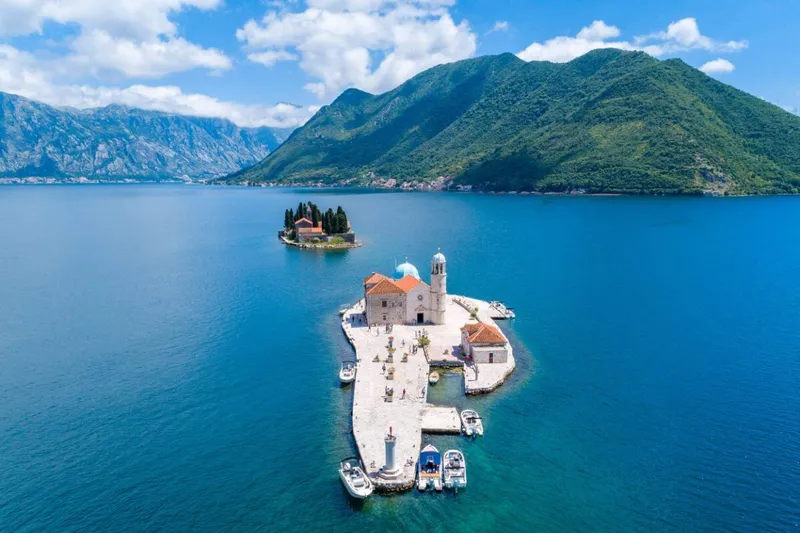
- Our Lady of the Rocks — Man-made island, 45m diameter, 1632 baroque church, open to all visitors, 20-min landing on most tours
- Mamula's draw — Dramatic scale, military history, visual impact from the water
- Our Lady's draw — Intimate access, religious art, 572-year tradition you can literally touch
- If you can only see one — Our Lady of the Rocks, because you can walk on it. Take a separate boat ride later to see Mamula at sunset.
For the full story of the other island, see our Our Lady of the Rocks story.
What to Photograph From a Passing Boat
A decade of running the Mamula pass, and five specific shots consistently come out best:
- Wide silhouette at golden hour. 30 minutes before sunset, shoot from 60–80 metres away with the western sun behind the camera. The circular wall reads as a single dramatic shape.
- Texture close-up. When the boat is closest (around 40m), shoot detail of the stonework — the masonry is from different eras, readable as horizontal bands.
- Low-angle approach. Shoot from water level as the boat approaches the northeast side, with the dock in the foreground and the wall towering behind.
- Mamula with Mount Orjen behind. Looking back from the open Adriatic toward the bay, the fortress sits in front of Orjen's 1,894m peak. Wide lens, late afternoon.
- Drone-style from the mast. If you have a captain willing to pause briefly, a phone raised overhead on a selfie stick gets a quasi-aerial frame that reveals the circular plan.
See Mamula on the 3h Blue Cave Adventure
The route passes Mamula, Blue Cave, Our Lady of the Rocks and Perast in one 3-hour loop. Four daily departures. From €45 per adult.
For the wider 2026 boat-tour schedule and pricing, see our complete Kotor boat tour guide. For the full Bay of Kotor geography and history, the Bay of Kotor guide places Mamula in its wider context.
Related reading on the bay: